

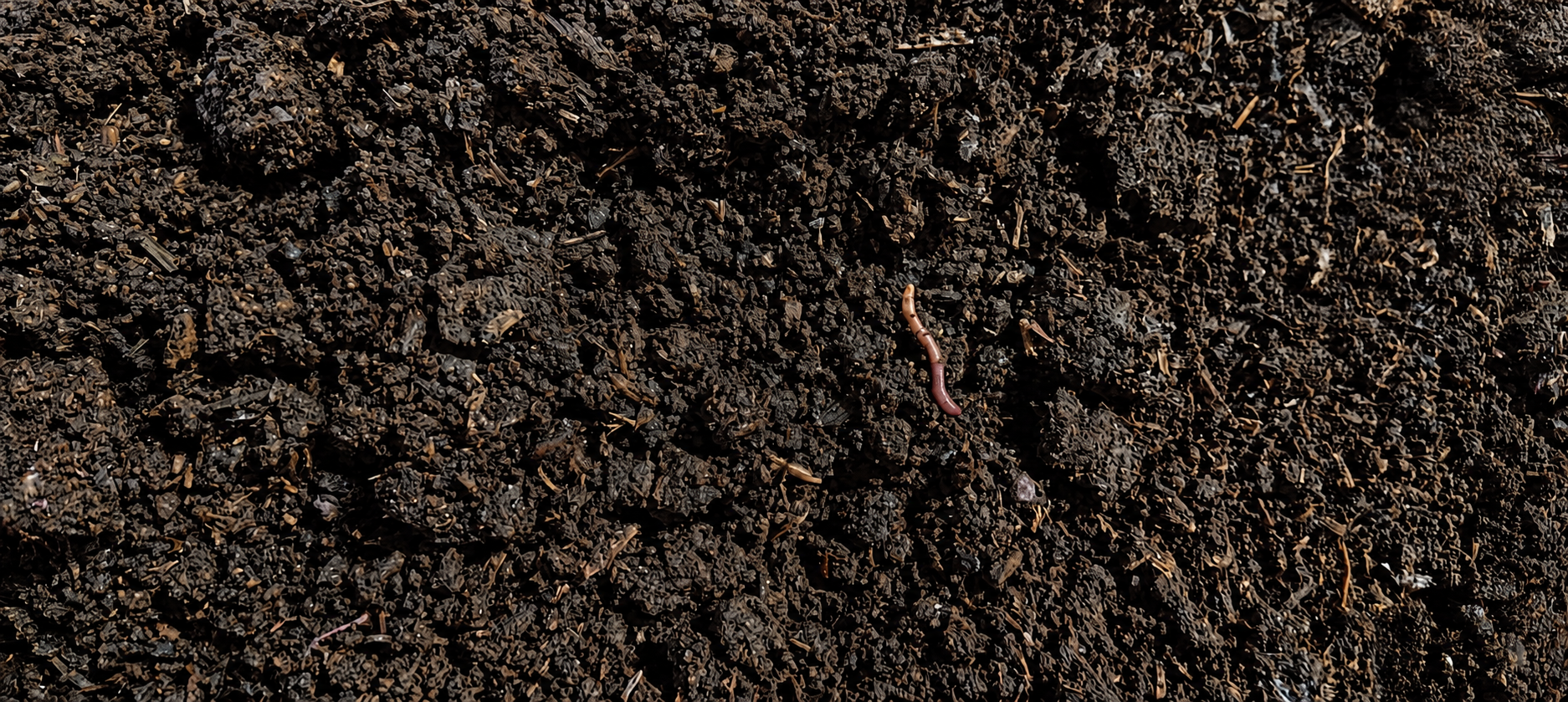
IMAGE: Midwest Soil Restore’s Premium Johnson-Su Compost, 04/17/2026.
JOHNSON-SU COMPOST & EXTRACT FAQS
-
A compost produced using the open-sourced bioreactor method developed by Dr. David Johnson and his wife Hui-Chun Su Johnson.
Dr. David Johnson is a molecular biologist at New Mexico State University’s Institute for Sustainable Agricultural Research.
Hui-Chun Su Johnson is also a scientist and has a background in working with scientific literature related to agriculture.
Johnson-Su compost is a fully matured (12 months), biologically active compost made in a static, aerobic bioreactor that is designed to produce a fungi-dominant, biodiverse microbial community.
Unlike compost used mainly as a bulk nutrient source, Johnson-Su compost is often used at very low application rates as a microbial inoculant to help restore soil biology and improve aggregation, water infiltration, nutrient cycling, and crop performance.
However, Johnson-Su compost is also a VERMICOMPOST-- Red Wiggler worms are added in the 1st month of cultivation and are still active in mature Johnson-Su compost.
-
The Johnson-Su system is different because it is static, aerobic, never turned, and composted for a long period, typically 9–12 months or longer, which supports more complete biological breakdown and greater fungi development.
Multi-functional: : It can be amended into soil or made into an extract (not tea), primarily used with a planter to spray in furrow, but can also be used for foliar spray, seed inoculation, residue decomposition, or soil drenching pastures.
-
Our Johnson-Su compost is produced with certified organic non-wood feedstocks, uniform mixing, temperature-controlled production conditions, multiple daily misting, and moisture monitoring to maintain consistent biology throughout the compost mass.
High microbial biodiversity: over 1,200 fungi species and over 3,000 other microbial species.
-
Store Johnson-Su compost like a living biological product: in a cool & shaded area, protected from direct sun, and not allowed to dry completely out or become waterlogged.
Do not completely close or seal up, it must remain aerobic. Cover partially to protect from direct sunlight and to prevent weed seeds from blowing in, but ensure it can still "breathe."
When properly stored, the compost (NOT extract) can last 2-4 years.
The Johnson-Su Extract should be used as soon as possible after extraction, up to 72 hours, and covered or kept in shade to protect from direct sunlight.
-
A liquid inoculant made by physically dislodging and filtering microbes from mature Johnson-Su compost in water.
Its main purpose is to deliver living biology, especially fungi and bacteria, to soil, seed, residue, or plant surfaces over a large area.
It is not primarily used as a nutrient fertilizer; it is used to reintroduce and distribute beneficial microbial communities that can UNLOCK unavailable N, P, and K forms ALREADY in the soil.
-
No. In the Johnson-Su system, an extract is made by vigorous mixing and screening of mature compost in water, with the goal of moving microbes from compost into solution for immediate use.
A compost tea is usually brewed over time, often with aeration and sometimes with added foods.
If you have other questions, please contact Steve.
USAGE FAQS
-
To make the concentrate for our recommended application rate of 1 pound per acre, add 1 pound of Premium Johnson-Su compost in 5–10 gallons of non-chlorinated water, mix vigorously for 5-10 minutes. Methods will vary depending on use and equipment. You can also reach out to one of our dealers in a location near you for fresh extract.
Click here to locate a dealer near you.
Click here for the How To Use page.
Click here to watch the Midwest Soil Restore How To Extractor video.
-
Make extract as close as possible to application. Midwest Soil Restore recommends using it within 48 hours, and preferably within 24 hours, because it is a living biological product.
For row crops, the most consistently recommended timing is at planting, especially in-furrow or as a seed inoculant, so the biology is placed right where the seed and new roots need it most.
For residue applications, your site recommends applying as soon after harvest as practical.
For foliar use, cooler low-UV periods such as early morning or evening are generally preferred so the biology is not stressed as quickly on the leaf surface.
-
We recommend 1 pound of Premium Johnson-Su Compost per acre as an extract, usually in 5 gallons of extract per acre for 30-inch rows, with up to 10 gallons per acre if using for pasture restoration.
For residue breakdown,we recommend ½ to 1 pound per acre in at least 10 gallons of extract, with more water generally preferred when practical. We can recommned lower application rates vs the standard 2 lbs. per acre because our compost has a higher fungi density than typical Johnson-Su compost.
-
The best fit depends on the goal.
For row crops, apply in-furrow at planting with planter spray nozzle is often the preferred method because it places the biology directly on the seed and in the root zone.
It can also be used as a seed inoculant, foliar spray, soil drench, fertigation input, or crop-residue spray.
We recommend screening the extract before it enters equipment, keeping it agitated during use, and thoroughly flushing planters, drills, and sprayers afterward to prevent plugging or biofilm buildup.
For detailed information on how to use, click here.
-
Yes, BUT ONLY with low salt liquid starters (e.g. 6-24-6), and ADD the extract to your planter tank LAST to minimize exposure time.
It would be preferable to use a dual tank planter if available.
Avoid hot/high-salt or strongly caustic products, keep the solution agitated, and use it immediately rather than letting it sit. -
Only briefly.
We recommends using extract within no more than 48 hours, preferably within 24 hours.
If it develops a foul odor, it has gone bad and should not be used.
In practice, freshest is best because microbial populations and oxygen status can shift quickly once the extract is made.
-
Do not throw it away.
The leftover solids still have value and can be returned to the soil, added to a potting or transplant mix, used around trees, gardens, or high-value plants, or reincorporated into a composting system.
Extraction removes some biology into the water, but it does not make the remaining compost useless. That leftover material still contains organic matter and biology, just at a reduced concentration compared with the starting compost.
-
Absolutely. One of the dominant fungi in our Johnson-Su Compost & Extract- Basidiomycota (Soil Architects)- are excellent for pastures that have become compacted by livestock.
Unlike in agricultural soils, where ascomycetes dominate, in grasslands, basidiomycetes are the major decomposers of dead organic matter (Deacon et al., 2006).
Basidiomycota help break up the "hard pan" and allows grass roots to go deeper, which keeps your pastures green longer into the summer heat.
Thes beneficial fungi produce extensive underground networks (mycelium) and create microscopic channels that allow oxygen and water to penetrate deep into compacted pastures.
-
Avoid chlorinated municipal water, as chlorine is designed to kill the exact biology you are trying to multiply. Use well water, rainwater, or de-chlorinate city water before mixing.
You may be able to evaporate chlorine from city water by letting it sit in your planter tank for 24 hrs, BUT ONLY if your city uses Chlorine. If your water provider uses Chloramine, it will not evaporate even after several days.
How to check: Call your local water utility or check their annual water quality report for "Chloramines."
You can neutralize city water with Vitamin C.
1.2 grams of (vitamin C) Sodium Ascorbate per 100 gallons of water (which safely neutralizes up to 3 ppm of Chlorine/Chloramine).
Food Grade Sodium Ascorbate or 100% Pure Sodium Ascorbate powder (often sold as 'Buffered Vitamin C') is readily available in powder or crystalline form from most health food retailers and bulk chemical suppliers. Ensure it contains no fillers, sugars, or artificial flavors.
This typically costs between $10 and $12 per pound and provides enough to treat several thousand gallons of water.